Connection: The not-so-hidden secret to meaning and happiness
This post expands on my #1 value, connection. I believe connection is the not-so-hidden secret to a happy and meaningful life. This is a doozy of a post, so buckle up...

When I reflected on my values, my #1 value was “connection”. (If you haven’t already done this exercise, do it now! It’s transformed how I live).
This post expands on my #1 value, connection. I believe connection is the not-so-hidden secret to a happy and meaningful life.
My definition is:
Connection is having deep relationships to all people, all living beings, and all things.
I have not always felt this way, and I’ve struggled in the past. Human nature and American culture have created barriers for my own journey to valuing connection.
Barriers to connection
The barrier to connection in human nature
As humans, we have a natural force that pushes us against connection. As the Arab proverb goes:
Me against my brothers. Me and my brothers against my cousins. Me and my brothers and my cousins against the world.
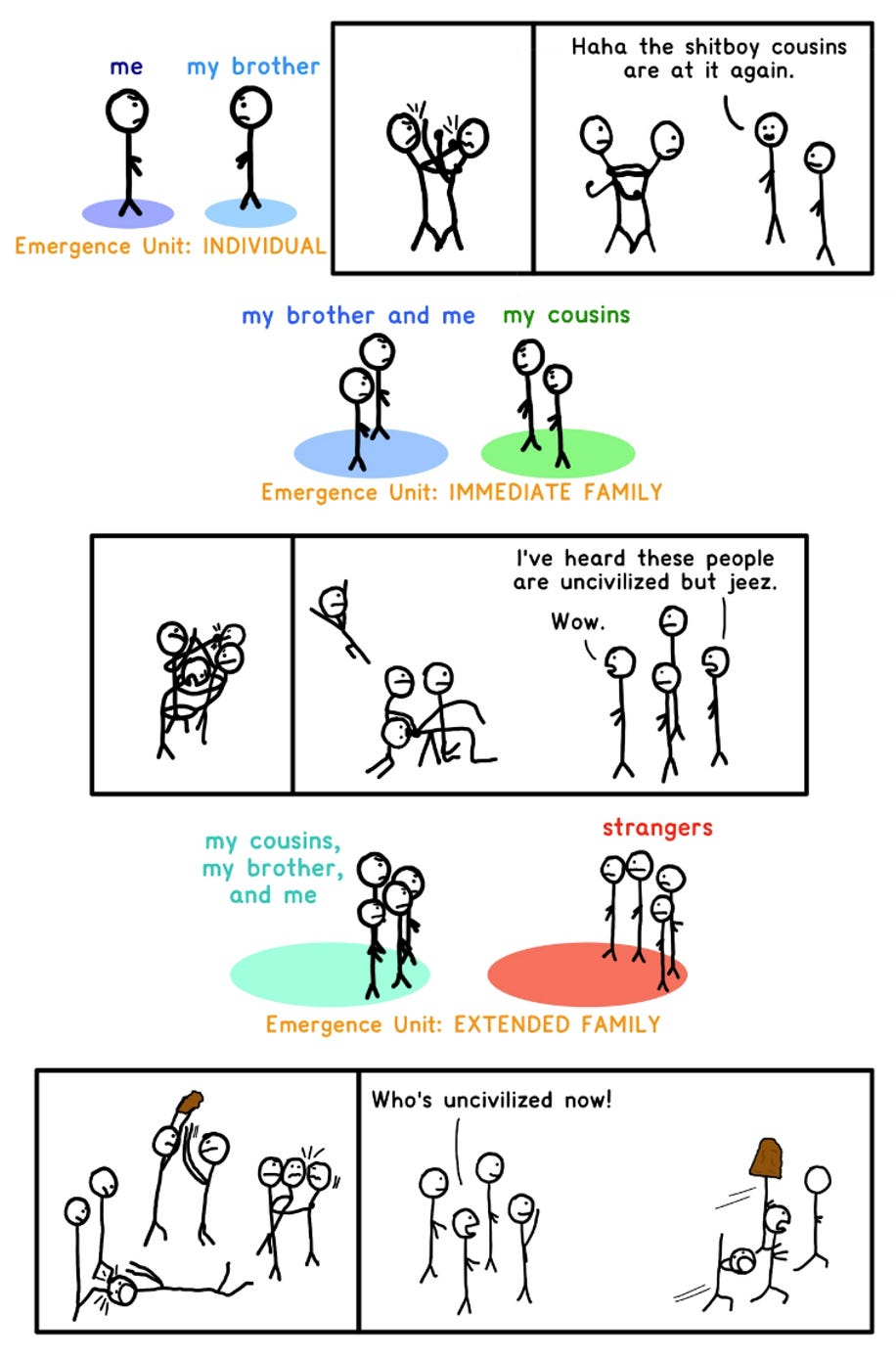
This mindset makes sense for people who evolved in a world pre-civilization (and given the slow pace of evolution, our brains are still biologically the same today as they were thousands of years ago). People then had limited resources and were governed by natural selection where only the strongest survived.
We have a natural desire to create “others” and to put ourselves in a “us vs. them” mindset.
The barrier to connection in American society
America is defined by individualism.
Social psychologist Geert Hofstede measured countries among 6 cultural dimensions ranked the United States #1 on individualism (the United States scored 91 on the scale from 0 to 100, the highest score in his data set of the 50 most populous countries in the world).
This narrative has been pushed throughout America’s history, notably by leaders like President Ronald Reagan, who was known for pushing the narrative that America was built by individual heroes. We see this narrative in the business world today with the idolatry of tech entrepreneur heroes like Steve Jobs, Jeff Bezos, Bill Gates, Elon Musk, and so many others who we like to imagine as the sole individual behind the most valuable gazillion dollar companies in the world.
This value of individualism is especially pronounced for men who are taught not to be emotionally vulnerable. And some trends around individualism are actually accelerating. The percentage of people who report having zero close friends has quadrupled in the last 30 years - from 3% to 12%.
My own barrier to connection
Growing up in the US, I’ve absorbed these values of individualism. 5 years ago, my top value would have been independence. I wanted to figure out life by myself: to solve problems on my own and to rely on no one.
This was also partly because I was just finishing college and starting to work full-time. As my first time generating my own living income, I wanted to live independently.
Beyond that, I felt burned out from my efforts to make connections during college. One of the biggest benefits of college was being surrounded by tens of thousands of bright minds tightly packed together in a few square miles with classes and clubs. And I dove into this opportunity and experience at the beginning.
But I stretched myself too thin, focusing on quantity over quality. I wanted to experience as much as I could, and I joined club after club each semester - cultural groups, mentoring groups, student government, campus tour guiding, greek life, swing dancing, engineering clubs, juggling clubs, etc. And I’d meet great people each time, but every time I switched my attention to something new, I’d lose touch with the old. I met people who I thought would be friends for life during my freshman and sophomore years, only to lose touch completely by senior year. I was overwhelmed by the number of people I was trying to meet.
By my last semester in college, I had developed some very bad habits, including:
Only having class 2 days a week and spending the rest of the time playing my Switch
Logging hundreds of hours playing FIFA Ultimate Team on the Switch (FIFA on Nintendo devices is bad. It’s like a time machine. FIFA 2018 is 5 years behind and the equivalent game of FIFA 2013 on Xbox/Playstation)
Ignoring Facebook messenger texts from yet another person asking if I wanted to buy tickets to their a capella concert
Ignoring other text messages from people in general
Flaking on events (this was really bad and once I learned I had this reputation I worked hard to remedy this)
One movie I watched recently reminded me of my individualist mindset at the time. It’s from Sing 2, which is the second of musicals about anthropomorphic animals who perform musical theater with catchy pop mega-hits.
One of the characters is a super-celebrity lion Clay Calloway (voiced by Bono of U2) who disappeared from the world and has not been seen in 15 years after his wife passed away. Part of the protagonist’s mission involves finding this celebrity and convincing him to come back to perform in his musical so it can be a success. Well, this lion turns out to be one hell of a hermit who lives alone in the mountains and who shoots down any visitors with a paintball gun, determined to stay alone forever.

So that’s sort of how I felt at the time. I wanted to figure out how I could live life as independently as possible.
From independence to connection
What changed for me?
Unlike in Sing 2, I did not have a porcupine voiced by Scarlett Johansson to smooth-talk me into snapping out of my hallucination (this movie has some serious star power behind it and it’s a lot of fun. Would recommend).
Two big things have helped me grow past my old mindset of independence into a new one valuing connection.
First, I developed a daily morning practice of yoga, meditation, and journaling that I maintained over the course of 2 years. Although I lost this habit during the shock to my routine that was COVID, this gave me routine gave me the space and mindfulness to reflect and change.
And second, I stumbled onto my best friend turned significant other who, over the course of the last 4 years, has helped me discover and - even harder - actually helped me believe in the power of connection. She’s steered me away from wanting to retreat into my own hermit castle.
Here’s what I’ve have learned over the last 5 years about connection.
Connecting with those closest to you: replacing misleading definitions of love
When used to describe relationships with those closest to us - our significant others and closest family and friends - I believe connection is a better, more specific, and more actionable word to describe a healthier version of what modern society calls “love”.
Love is an overused and confusing word. One can say, “I love to eat Ben and Jerry’s Americone Dream ice cream,” and as delicious as that combination of crunchy waffle cone, chocolate, and caramel on top of vanilla is, it doesn’t mean the same thing as the magic 3-letter phrase “I love you”. When combined with the Hollywood fairytale description of love at first sight and “falling into love”, it’s easy to confuse what love actually means.
While less romantic, connection is an active word. Connecting with the people closest to you is actionable. It shows you how to build and grow your relationships.
“Love” requires proactivity and action
The late psychiatrist Scott Peck described love in his book The Road Less Traveled as the following:
True love is not a feeling by which we are overwhelmed. It is a committed, thoughtful decision.
It’s so easy to think of love as a feeling that comes without effort. This leads to a staggeringly high divorce rate in the US of 39%. Although better than the 50% it used to be, that’s just 61% of marriages that last, a D- grade for a commitment that is supposed to last for life.
Stephen Covey describes this well in his bestseller 7 Habits of Highly Effective People:
Love is a verb. Love - the feeling - is a fruit of love, the verb.
Focusing on connection instead of love shows the action needed to build relationships. Connection isn’t just a feeling. Connection is actively built.
Connection as an activity
There are simple ways to establish connection with those who are closest to us.
Clinical psychologist Dr. Becky Kennedy created a “fill-up” game with her kids to build connection:
One of my kids was really struggling…I was like, “What if I looked at all of these moments through the lens of my, my kid feels really disconnected to me, or scared of really being disconnected?”
So I started doing this thing called the fill-up game, where every morning I'd say, “I'm gonna fill you up with mommy.” I'd say like, “What percentage are you?” and inevitably, he'd say, “I'm 5% filled up”, and I'd give him this huge hug. I'd say, “Ooh, what about now?” 10. “Ooh, what about now?” And when I get to a hundred, or if your kid says instead, “Oh, now I'm finally up to my head”, kind of put the zinger on it and say something like, “Well, let me give you one more because it's good to go in with a little extra.”
I love this way of reframing love through connection. It’s something my partner and I use frequently. We’ll ask the question:
“How connected are you?”
If she says that she’s at 5% connection - which might be the result of an argument - then I know to be extra thoughtful to do something to increase that connection, which can often be as simple as planning a meal together or a simple hug.
Repeating the question helps us measure how effective our connection attempts are. Different people have different “love language” preferences (the 5 love languages are Words of Affirmation, Physical Touch, Gift Giving, Acts of Service, and Quality Time). The most intuitive way to connect and express love is through our love language, even though others usually have different preferences.

My top love language is Physical Touch. So if she expresses that she’s at 5% connection, my first instinct is to hug her. But if I ask her again, she might she say that she’s still only at 6% connection. This way I know another path is more effective, like cooking a meal for her - as her top love language is Acts of Service (followed closely by food, which is definitely another love language).
Love is a fundamental human need. Most of the time, most people are just looking for love. Infants in orphanages are much more likely to die unless they are hugged (shown love), even if they are cared for well physically.
By realizing and understanding how love is better expressed through connection, I’ve developed an improved understanding of both how to love while also building belief in the value of connection.
Connecting to all people and understanding our shared humanity
Connection helps me understand how I fit with all people, not just those closest to me.
In everyday life, it’s easy to forget how deeply all people are connected to each other. This is a shame because connecting with people in general has great benefits.
There’s a simple exercise from engineer/author/philanthropist Chade-Meng Tan as described in Tools of Titans by Tim Ferris that illustrates this. The exercise is extremely simple and will boost your happiness in 10 seconds. Here it is:
If you are currently around other people, randomly pick 2 of them. Ideally they are strangers who you do not know.
Think to yourself the phrase: “I wish for this person to be happy, and I wish for that person to be happy.”
How do you feel? Almost without fail, this simple exercise will make you smile.
You can feel happiness from wishing other people happiness. This has also been described as “Freudenfreude” (the opposite of Schadenfreude):

Let’s just pause for a minute and reflect on this fact. Isn’t it fascinating that we can take pleasure in other people’s happiness? It’s so easy to live in our own worlds and focus on how we are different and separate from others. Why should other people’s happiness or emotional state affect our own?
Connecting with people to boost your resilience
Connecting with other people, and with the human experience in general, can even boost your resilience.
This is described in The Book of Joy by Douglas Abrams, which captures wisdom from two spiritual giants: the Dalai Lama and Archbishop Desmond Tutu.
“Many of us have become refugees,” the Dalai Lama tried to explain, “and there are a lot of difficulties in my own country. When I look only at that,” he said, cupping his hands into a small circle, “then I worry.” He widened his hands, breaking the circle open.
“But when I look at the world, there are a lot of problems, even within the People’s Republic of China. For example, the Hui Muslim community in China has a lot of problems and suffering. And then outside China, there are many more problems and more suffering. When we see these things, we realize that not only do we suffer, but so do many of our human brothers and sisters. So when we look at the same event from a wider perspective, we will reduce the worrying and our own suffering.”
I was struck by the simplicity and profundity of what the Dalai Lama was saying. This was far from “don’t worry, be happy,” as the popular Bobby McFerrin song says. This was not a denial of pain and suffering, but a shift in perspective—from oneself and toward others, from anguish to compassion—seeing that others are suffering as well. The remarkable thing about what the Dalai Lama was describing is that as we recognize others’ suffering and realize that we are not alone, our pain is lessened.
The most powerful part of that story as summarized by Abrams:
As we recognize others’ suffering and realize that we are not alone, our pain is lessened.
Since humans came into being over the last 200,000 years, 100 billion total people have lived. And people are 99.9% genetically similar to each other. These 100 billion people have all experienced what it means to be human. They have all felt joy, suffering, anger, fear, excitement, stress, pain.
This benefit has been proven scientifically. As explained in The Upside Of Stress by psychologist Kelly McGonigal:
People who understand that suffering is part of everyone’s life are happier, more resilient, and more satisfied with life. They are more open about their struggles and more likely to receive support from others. They are also more likely to find meaning in adversity and less likely to experience burnout at work. And yet, despite the benefits of recognizing common humanity, people often underestimate the stress in other people’s lives and overestimate other people’s happiness.
Connecting with other people is good for you.
One note - McGonigal does recognize that “people often underestimate the stress in other people’s lives and overestimate other people’s happiness”. More on this later as we address some of the pitfalls of connection, like social media.
When connection to other people is missing
One way to show the importance of connecting with people is to look at what happens when it’s missing. A common tactic used throughout history to deliberately sever connection has been dehumanization.
Slaves have been dehumanized throughout history by being classified as property. The Nazis used dehumanization tactics to cause the Holocaust. The US used dehumanization against the Japanese to justify internment camps.
Dehumanization is the tactic that makes people forget about how they’re 99.9% similar. It’s probably a requirement to cause mass suffering.
The examples above are extreme, but smaller ways of dehumanization show up in everyday life today. It’s what’s causing the tribalism and polarization between the “left” and the “right” in American politics today. It’s much easier to criticize the opposite side of the spectrum by labeling them one-dimensionally and forgetting that they too are human, and they experience the same things you do.
Some thought exercises to remember connection with all people:
Connecting with people and the human experience is important, but it’s easy to forget. Here’s some thought exercises that help me:
Questioning the little things:
One day, I found myself wondering about a series of simple questions.
Where are you as you read this, and who built that space?
What are you reading this with, and who built and invented that device?
What did you do today? Did you drive? Did you walk? Who built the car you used? Who made the sidewalk you stepped on?
What are you wearing, and who designed and made it?
I realized that the answer to all of these things was simple: people. Our lives are built by other people.
Perspective:
Imagine if you were to travel to another planet, and you were truly all alone. You are literally the only person on the planet. Pretty lonely, right?
If you were to meet another person, you would realize how similar you actually are.
Connecting with everything: all living things and the world around you
Connecting with people as a whole is important, but why stop there?
One of the reasons why I value connection is because it helps me remember how I’m connected with everything, not just people. This includes all living things: animals, plants, etc… It also includes non-living things.
Connecting with other living things
People are connected with all living things. One of the most obvious examples is how people relate to our pets. Our family recently welcomed a new member of the family, a Maltese/Poodle (Maltipoo) named Lulu.

Lulu is a fluffy ball of joy. There’s nothing quite like seeing her in the morning and seeing her wag her tail, jumping up and down, paws up, licking and kissing out of excitement.
Dogs foster connection with other people too. Whenever I am out walking with my parents and Lulu, it’s remarkable how often people will stop to comment on how cute Lulu is. She sparks connection not only between human and animal but also human to human.
Our connection to animals has proven benefits. In Being Mortal, Atul Gawande explains how introducing a total 100 parakeets, 4 dogs, 2 cats, and many rabbits and hens to a nursing home injected the entire place with life:
People who we had believed weren’t able to speak started speaking. People who’d been completely withdrawn and nonambulatory started coming to the nurses’ station and saying, ‘I’ll take the dog for a walk.’ All the parakeets were adopted and named by the residents. The lights turned back on in people’s eyes.
A two-year study on the intervention revealed the following:
The number of prescriptions required per resident fell to half that of the control nursing home. Psychotropic drugs for agitation decreased in particular. The total drug costs fell to just 38% of the comparison facility. Deaths fell 15%.
Taking care of pets - connecting with them - tapped into people’s fundamental need to have a reason to live.
Connecting with the world
We’re connected to everything. The following thought exercise about people illustrates this:
As taught in high school biology class, people are made of cells. We have a lot of them - about 30 trillion. That’s a big number! If each human cell was the size of a ping pong ball, you could spread out that many ping-pong-ball cells over the entire surface of the Moon. 1,000 times.

Each of these cells are alive. They aren’t that different from the single celled organisms that populated Earth billions of years ago.
But here’s a wild fact - you also have about the same number - 30 trillion - of bacteria living in your body as well. Most of these bacteria are harmless or even good for you.
You can break this down further. Just 6 elements on the periodic table - oxygen, carbon, hydrogen, nitrogen, calcium, and phosphorus - make up 99% of people.
Where were these elements before they were part of us? Some spinach plant? A cow muscle cell? Where was that carbon atom 4 billion years ago? Swirling around in the atmosphere of an early forming Earth? How many people and living things did the oxygen that you are breathing in right now pass through before it reached its current destination of you?
I like to also take this thought exercise and go the other direction as well. As people, we are made up of 60 trillion cells and bacteria. What happens when you combine 7 billion people together? How about when you combine that with 3 trillion trees? Over a quadrillion spiders? (I had trouble finding a great source for this spider number but it seems like a quadrillion is reasonable.)
This idea that everything is connected isn’t a new idea. It’s why we call our planet Mother Earth. The Earth, made up of living parts which interact with each other, is alive.
Some of the lucky few who see this are astronauts. When they see the Earth from space, many astronauts feel this sense of connection. This phenomenon is so common that there’s even a name for it - the Overview Effect, coined by space philosopher Frank White. From astronaut Scott Kelly:
You realize looking at the Earth, that despite its beauty and its tranquility, there's a lot of hardship and conflict that goes on. You look at the planet without borders, especially during the day. At night you can see countries with lights, but during the daytime it looks like we are all part of one spaceship, Spaceship Earth.
And we're all flying through space together, as a team, and it gives you this perspective — people have described it as this 'orbital perspective' — on humanity, and you get this feeling that we just need to work better — much, much better — to solve our common problems.

The dark sides of connection
Connection is great. But connection, like all things, does have some dark sides.
It’s nuanced, but there are flavors of connection that can be negative. Here are a few that are top of mind:
Social media
There’s a lot of evidence that points to Instagram having negative effects on people’s mental health, especially for teen girls. 32% of teen girls said that when they felt bad about their bodies already, Instagram just made them feel worse. Instagram has been linked to depression, body image concerns, self-esteem issues, social anxiety — a whole host of bad things.
Yet Facebook’s (now Meta) founding mission sounds so similar to what I’ve been writing about this entire post.
Giving people the power to build community and bring the world closer together.
How can something that sounds so good cause so much harm? What differentiates good connection from bad?
For me, the key difference is depth. Social media does connect people, but it usually does so in the most shallow way - through likes, hearts, comments, follows, and “friend” requests. It gives clear metrics on just how popular you are - or more commonly, how much less popular you are than everyone else. It reduces quality of connection in favor of quantity.
This lack of depth contributes to the caveat in psychologist Kelly McGonigal’s explanation about the benefits of connection:
And yet, despite the benefits of recognizing common humanity, people often underestimate the stress in other people’s lives and overestimate other people’s happiness.
By seeing only the surface on social media, we get a false picture of other people’s lives. We only connect with their best moments, not their full humanity, and that makes us feel bad.
Conformity
Another extreme version of connection is conformity. Conformity happens when people are connected in a group but everybody thinks the same thoughts and behaves the same way.
When everybody in a group thinks the exact same thoughts and behaves the same way, that group is stuck. It can’t grow. It can’t respond to change. If the group has a false belief, there’s nothing that will change it. While conformity isn’t strictly bad in every context, bad things can happen when groups of people turn off their brains to conform.
Blogger Tim Urban’s book What’s Our Problem does an excellent analysis of this phenomenon in depth.
When a group of people think in conformity, that leads to Echo Chambers. Echo Chambers leads to “Golems” - groups of people that are big and stupid and that force their values on others, even if those values are false.
He also describes the opposite, which is when people connect but think with independent thought, not conformity. This leads to the opposite of Echo Chambers, with is Idea Labs. This creates the “marketplace of ideas”, which is how our society progresses.
The marketplace of ideas is like a giant communal brain that allows the country to think for itself and, over time, point the country in the direction of truth and progress.
When connection is paired with free speech and independent thought, the opposite of conformity, it leads to truth and progress.
Dependence
Another version of connection is dependence. Dependence is connection, and it’s not strictly bad. But too much dependence among people is suboptimal.
Dependence shows up in different ways:
Physical dependence is relying on other people to move. Human babies are physically dependent on their parents to move or for their most basic needs.
Emotional dependence is depending on what other people think, like counting your Instagram likes as a proxy for your self-worth.
Intellectual dependence is the inability to think critically. It means that you simply think what you are told.
These don’t sound great, right? When I was seeking independence 5 years ago, I wanted to avoid all of the above.
I was focused on moving from dependence to independence. However, as described in Stephen Covey’s 7 Habits of Highly Effective People, I was missing the next step: interdependence.
Covey describes this concept with the “Maturity Ladder”. Let’s apply the maturity ladder to a simple example: it’s dinner time, I’m hungry, and I need to get eat.

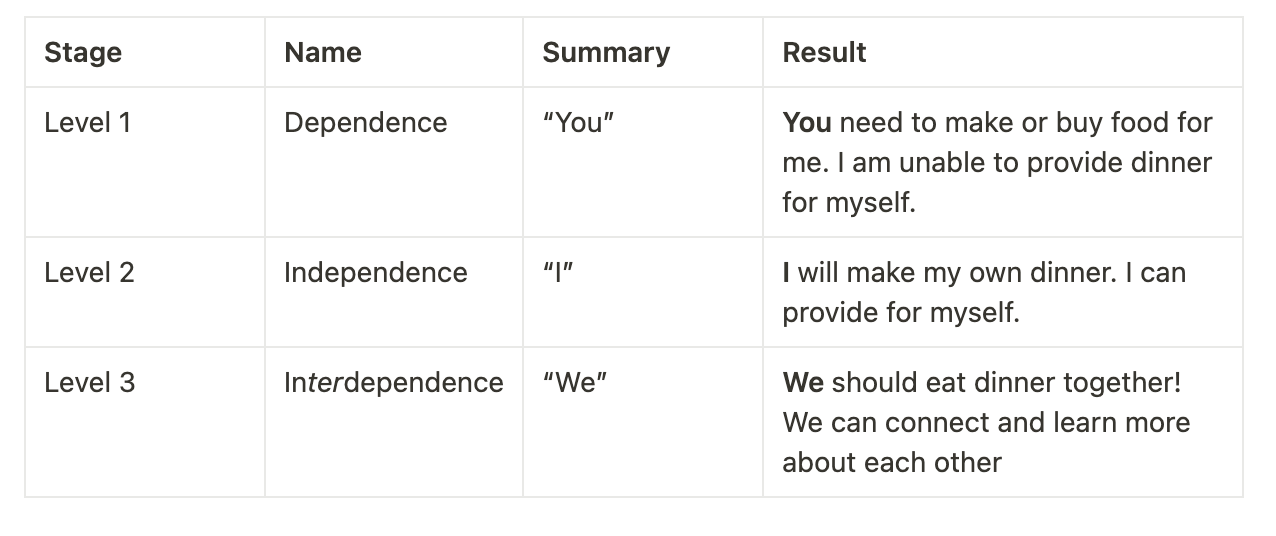
By choosing to eat dinner with someone else, even if I could have eaten alone, I’m connecting with others. It took me a while to make the leap that interdependence is very different from dependence. Interdependence leads to the saying, “the whole is greater than the sum of its parts.”
Closing thoughts
Phew! That was a lot. Guess I have a lot to say about connection.
One closing thought: I want to share one of my favorite books ever: On Living by Kerry Egan.
This book changed my life. When I first read it (my girlfriend gave me the book, bless her), I was in a bad emotional state. I started it that evening and finished it at 3am, in tears. Not sad tears, but healing tears. As I devoured the book, I felt like I was healing.
This book is filled with beautiful and heart-wrenching stories. One of the many that stuck with me is below, when the author is talking to one of her patients. She is asking about the day her patient was “saved”.
Her patient’s response was beautiful:
I can close my eyes and feel it again….That day seemed no different. But then. Then. I never really understood what happened, but when I walked out of that tent, suddenly the leaves were so green on the trees. I don’t know how I had never noticed that green before. It was like the color on the whole world was turned up. I could see every single blade of grass. I could hear every bird sing. I could feel each ray of the sun on my skin. And I knew it right then, that Jesus loved me and died for me and I was saved because he loved me so much. I knew he was the Lord. Everything was so beautiful, so alive. The whole world had changed. I didn’t know how I hadn’t seen it before. Everything changed because I was saved. Or maybe I was saved because everything changed.
Everything was so beautiful, so alive. The whole world had changed.
Beautiful, right? For me, connection evokes this same feeling of being “saved”.
It’s so easy to feel separated. It’s easy to see existential threats like climate change, nuclear war, AI, the heat death of the sun, and wonder what the point of anything is, to respond with nihilism.
But there’s another path: to cherish the connections that we do have and to use connection to live with meaning and purpose.
That’s how I want to live, and that’s why I value connection.